Social entrepreneur Jane Milburn says we can leave home without eating but never without getting dressed! Clothing, like food, is essential for health and wellbeing. Our clothes do for us on the outside what food does inside. They protect and warm our bodies, and influence the way we feel and present to the world.
Dressing is an everyday practice that defines and reflects our values. We are naturally attached to clothes on a physical, emotional, even spiritual level. We are particular about what we wear because we want to look good, feel comfortable, reflect an image and belong. Yet almost all our garments are now designed for us and we simply choose from ready-made options based on our age and stage of life, work, status and spending capacity.
Unless we deliberately choose to step off the fast-fashion treadmill, we are trapped in a vortex with little thought beyond the next new outfit – without consideration for how we can engage our own creative expression, energy and skills to the textile resources that are already available all around us.
At this point in history, there are apparently enough garments already existing to clothe the next six generations. About 150 billion garments are produced globally every year as fast fashion becomes ultra-fast. They’re cheap and very few are special. Two thirds of new clothing is made from synthetic fibres derived from fossil fuels. These are effectively plastic and may never breakdown. Instead they shed microplastic particles into the ecosystem with every wash, and microplastic is appearing in our bodies and 80% of drinking water with the likely source being abrasion of synthetic clothes, upholstery, furnishing, toys and carpets.
In developed nations like ours, most of us are spoilt for choice with every conceivable item of clothing available in a plethora of colours, styles and sizes ready for our consuming pleasure. New styles arrive every week, not every season as used to be the case.
The average Australian now buys 56 items of clothing per year – we are the world’s largest consumer of textiles per capita, followed by the United States.
Fashion automatically comes with perceived obsolescence – the orchestrated creation of dissatisfaction that underpins consumerism. A continuous stream of new garments are purchased as older garments, no longer considered socially valuable, are shed into the secondhand clothing trade or landfill.
Attitudes are changing now that we have seen the amount of waste fashion generates – over 200,000 tonnes of clothing end up in Australian landfills annually or 6000kg every 10 minutes.
Think about what you chose to wear today. If you are wearing something locally made, that’s a rarity these days. Even more-rare and special is to wear something you made yourself. Research shows the manual activity and process of craft allows us to regain a sense of control and empowerment over the fashion system.
Gaining skills and knowledge to regenerate our agency in the wardrobe can help drive systemic change and create financial and wellbeing benefits.
I grew up at a time before fast fashion on a sheep farm so I’ve always loved natural fibres. I studied agricultural science, had a career in rural communications and was selected for the Australian Rural Leadership Program which teaches people to step up and lead where they see it is needed.
My work since 2013 has been raising awareness about slow clothing, natural fibres and upcycling as the antidote to fast fashion. I set up Textile Beat to have independent voice around the ethics and everyday choices in what we wear. The problem I was addressing is this: the combination of modern-day slavery and the rise of synthetic fibres means we buy 2-4 times more than we need, causing waste and pollution, and a loss of skills and knowledge about clothes. My work is local and global, purposeful and impactful:
• At my TEDx talk 8 years ago, I used a 23kg suitcase to represent the annual volume of textiles and leather each Australian sends to landfill. I calculated this using simple maths (total textile waste from ABS divided by the population at the time) and that figure was quoted by everyone from the Federal Government down until more definitive research was done.
• My book, Slow Clothing, shares ways to reduce our material footprint and was launched in Sydney by ABC War on Waste presenter Craig Reucassel, in Melbourne by Costa Georgiardis and in Brisbane by Rebecca Levingston. It is used in New York sustainable fashion programs and a quote from it sparked the Make Something campaign in Europe alongside quotes from Margaret Mead, Jane Goodall and Stella McCartney.
• I always wear natural fibres, and often they are preloved. This upcycled geometric dress I made from a beautiful old linen tablecloth and napkins and linen from my stash. This is a pattern I created to suit my shape. It is flexible sizing and uses squares and rectangles of material with circles for my head and limbs to go through. This pattern uses a technique known as subtraction cutting.
Albert Einstein said: we can’t solve problems using the same kind of thinking that we used to create them.
This is why I developed Slow Clothing as the philosophical antithesis of fast fashion. Slow Clothing is a way of thinking about, choosing, wearing and caring for clothes so they bring meaning value and joy to everyday.
After working in this space for nearly a decade, I won a Churchill Fellowship to research how becoming more involved with your wardrobe can help reduce textile waste and enhance wellbeing.
Clothes that mean something to us personally, that carry a good story about how they came to be in the world are much more likely to last in our wardrobes than flash and crash fashion.
One of the people I met on my Fellowship in the United Kingdom was Professor Kate Fletcher who said most of us have a fairly lifeless and disappointing relationship with our clothes. Products on sale on the high street or online are homogenous and this lack of choice erodes our individuality, dulls our imagination and distances us from the creative process.
She said ready-made garments appear to offer us the promise of something better than we could make ourselves. Although when we go down the route of buying into this perceived perfection, we end up forgoing an opportunity to learn how to make things and become more skilled. As deskilled individuals, we play into the hands of consumerist fashion.
Prof Fletcher is co-author of Earth Logic: fashion action research plan for profoundly rethinking fashion in the face of the climate crisis. Earth Logic is a free downloadable pdf if you want to know more.
Another person I met on my Fellowship travels was Associate Professor Otto von Busch in New York. Otto said: “Fashion thrives on people’s uncertainties and anxieties. It needs people to not feel good about themselves, to come back next season and buy new clothes otherwise they lose their market.” He said fashion consumption today is so user friendly, low cost and accessible … that we, you know, we are a bit lazy, and we are compliant with the current arrangement of things.”
Otto’s research is based on the idea that the transformation of clothing and the transformation of self are connected. Gaining skills to tinker our clothes and cultivate our own fashion-abilities, along with the courage to play and experiment with our clothes and our style, present an alternate fashion future. A future in which we have regenerated our own agency.
He said: “Everything is just a click away and, of course, that becomes the easiest way to engage with the world. So people think why would I need to learn other skills then? And he thinks that this produces more alienation and traps us where we become dependent on the freedom that our money buys us, rather than the freedom of our own agency to do things ourselves.”
“We live at a time when clothes are cheap, when buying the fabric to make a garment is more expensive than buying finished garments. But we have a surplus of garments dying in the back of the wardrobe and they can be the material by which we learn and cultivate skills.”
My fellowship was about disrupting the fashion system through the power of consumer behaviour and choices – because there is no better time for the citizenry to be activated and engaged through everyday practices. It is about taking charge of our clothes, divesting ourselves from dependency on destructive systems by becoming actively engaged in and caring for what we wear rather than passively choosing from the latest offerings. It is grounded in the practices, choices and actions that reduce our material footprint: think, natural, quality, local, few, care, make, revive, adapt and salvage as outlined in my Slow Clothing Manifesto.
It is about regenerating our own agency and being empowered through skills, knowledge and desire to assemble a wardrobe of garments that we want to wear and keep in service for as long as possible. Agency is attained through simple skills to undertake acts of styling, mending, co-designing, and upcycling to appreciate and value the natural resources that go into clothes and manipulating them to fit our needs. Being more engaged with our clothes is a driver for systemic change as well as bringing with it financial, environmental, empowerment and wellbeing benefits. At its simplest, it is being resourceful and using commonsense; neither expensive nor particularly difficult.
Across the world, I found many individuals, academics, social enterprise and small business change agents envisaging and implementing small and slow solutions that can help people solve problems in their wardrobes. Hands-on upcycling actions’ we can take include: thrifting, styling, mending, making, remaking, embellishing, adapting, tinkering, redesigning, restyling, refashioning and repurposing.
Before we see the original, beautiful and resourceful garments made by Kim Bailey from East of Grey at the Gold Coast, I’d just like to leave you with my Slow Clothing Manifesto and the 10 ways you can reduce your material footprint.
The first five are for those who think they don’t have time to be actively involved, and the other five are for those who want to dive in.
• think – make thoughtful, ethical, informed choices
• natural – treasure fibres from nature and limit synthetics
• quality – buy well once, quality remains after the price is forgotten
• local – support local makers, those with good stories and fair trade
• care – mend, patch, sort, sponge, wash less, use cold water, line dry
• few – live with less, have a signature style, a minimal wardrobe, unfollow trends
• make – learn how to sew as a life skill, value DIY and handmade
• revive – rewear, relove, vintage, exchange, op shop, rent and swap
• adapt – upcycle, refashion, eco-dye, create new from old
• salvage – donate, pass on, rag, weave, recycle and compost
So in summary, we resist fast fashion’s influence by asserting our individuality, originality and creativity. We have done globalization, it works for those who control the power and money. Cheap clothes bought online or in big fashion stores arrive on the back of exploitation of resources and people in places unseen and offshore. With a return to localism, there is potential to care, share and create a better ecosystem. We nurture local production when we are prepared to pay a little more for place-based products. We need to value low clothing miles and local clothing as we do low food miles and local food. And that quote of mine used in the Make Something Campaign is this: “In the rush to own things for reasons of status and looks, we lose the opportunity to be mindful and resourceful through the act of making and creating.”
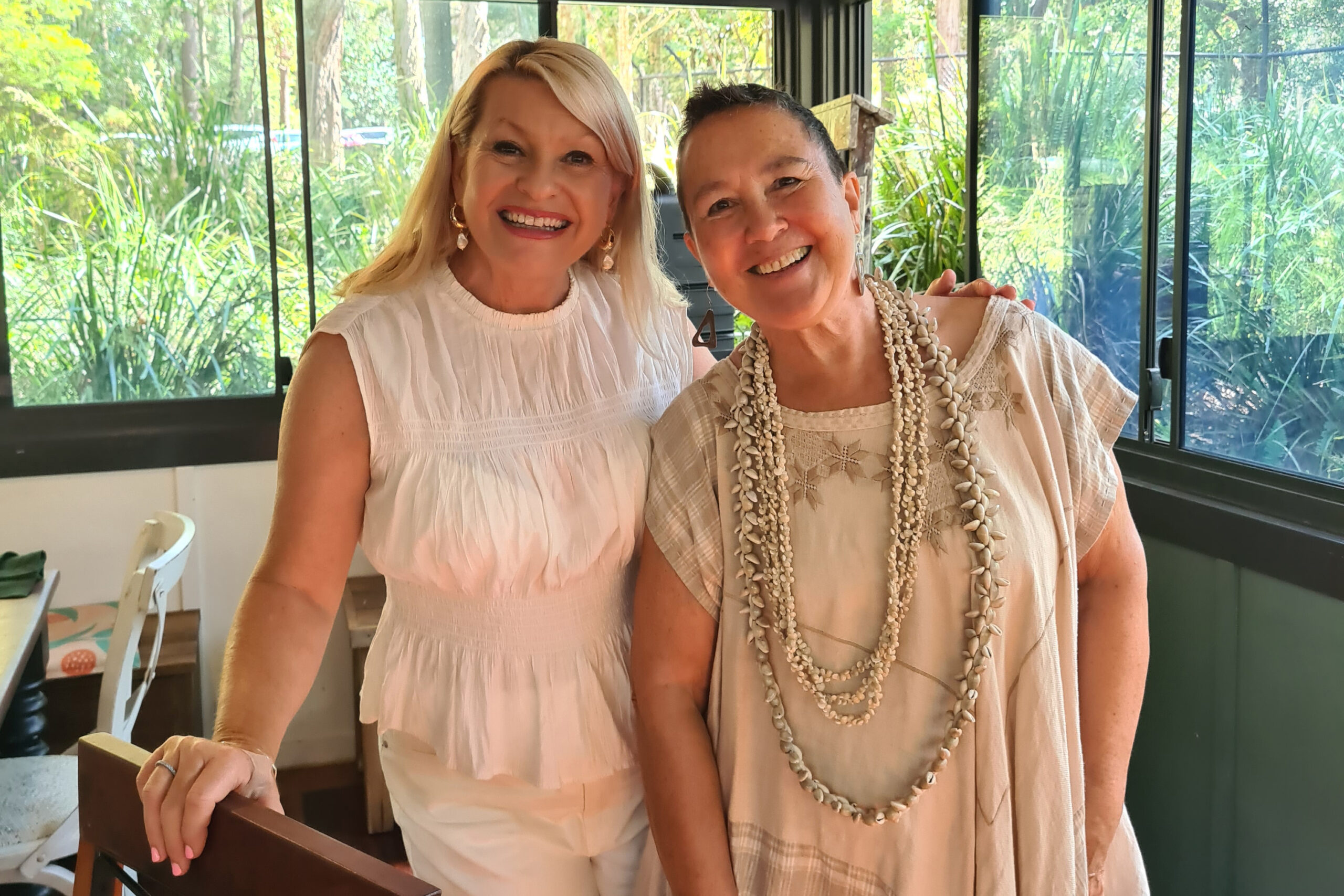
Speech by Jane Milburn at Indigiscapes in December 2025. Photo of Jane Milburn with Ranger Stacey.